Module 3 - Digital Skills in Practice: Game based Learning
- Mr Nick

- May 6, 2024
- 6 min read
Module 3, Unit 4, Activity 2
Show me what you know
Nikola Stefanovic
Overview
I had a group of my students begin designing a board game during our project assignment. As part of the design, they were tasked to define the rules of the game, come up with questions and explain it all to the rest of the class.
Instructional Objective
Over a 10-day period, the students have had 3 separate occasions, each lasting around 40 minutes, to finish making the game. They were supposed to plan the whole project from start to finish. Some of their tasks included identifying the materials they will need, writing down questions and answers, creating a game board, and presenting their finished game to the rest of the class.
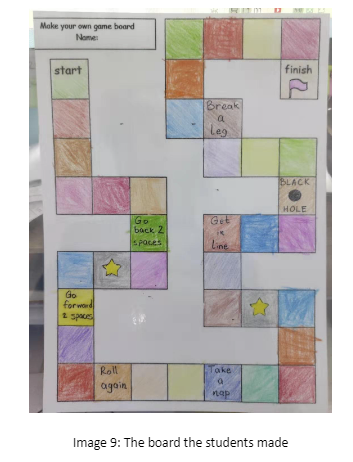
Each student took on a part of the work, but all were tasked with coming up with questions that were related to the content we learned before. For instance, our most recent topic were injuries, and one of the trick fields was “Break a leg”, meaning that the player’s next roll of dice would be lower by 1.
Some examples of question are “What is the capital of America?”, “Who are the characters in the story ‘Creep low, fly high’?”.
The objective of this project is to tie in the content with a fun activity, and thus get the students to review what they learned before. I recently heard about teachers leaving some space at the end of a test with the instruction “Show me what you know”, as a way to get students to demonstrate their knowledge, outside of the confines of teacher’s questions. I tried to apply that concept here.
Learners
The group working on this game consists of 3 boys and 1 girl, all aged 8-9. These are Chinese ESL learners, living in a relatively expensive neighborhood in Beijing, with some of the best public schools in the country. They have been learning English for 3+ years.
The target players are students in this class (12 of them with similar backgrounds), and other classes at comparable levels.
Motivation
The students in this and other classes at my training center are eager to play games and do group work. They have played this type of games before and know the general structure well.
Students in this class are generally active in class and motivated learners. The questions are broadly related to the material we’ve covered in the past several months. The topics range from reviewing the stories we read (questions about the characters, settings, main ideas, key details, causes and effects, problems and solutions…), to specific knowledge from Social Studies, Math and Science parts of our curriculum (money and trade, addition and subtraction problems, 2D and 3D shapes, life cycle of plants and animals, pollution, weather and seasons…).
The idea to make a game came out of brainstorming what kind of a project we could do because one of the proposed ideas in our lesson plan was not relevant to the students (describing a family business, where none of the students’ families had one).
Context of Use
Ideally, the game board could be used in the future, with new sets of questions. The students can be assigned to come up with a number of questions themselves (as homework), and they can be the ones testing their classmates’ knowledge.
It’s both a reward, and an assessment, as well as a form of gauge of what the students feel are the real takeaways from our lessons.
Scope
If the game is played until one player reaches the end, the game would take around 10 minutes. If the players decide on different ways to end it, it could last longer.
One very positive aspect of this board game is that it can be adapted to fit any subject or content. It all depends on the types of questions on the list. I chose to have the students make their own list of questions, but a teacher could make their own. I will probably do so in the future. And I intend to add a few questions of my own to this class’ list.
If one so chooses, the questions can be arranged so that the more difficult ones are grouped according to some principle (easier at first, more difficult towards the end; every 5th question is more difficult…).
I asked the 4 students to each come up with 5 questions at home. There are also the trick questions and special spaces, so the entire game would have around 30 spaces. In the future, all students in the class can be tasked with bringing a few questions of their own.
Object of the Game
The goal of the game is to advance from Start to End. Each time a player lands on a space he has to draw a questions and answer it. The first player to get to the End wins.
Alternative ways to play:
in teams, where each team has to answer the questions collectively.
the questions can be weighted, or each could carry a certain number of points. Once all players are at the End, the points are added up and the one with the most points wins.
Easy mode: advance no matter how you answer the question; Medium: deduction if you don’t answer, or if you ask for help; Hard: go back to the starting space, or wait out one turn if you can’t answer the question.
Design Details

Sources: https://en.calameo.com/read/00455866060cbc1599e27 ; https://www.bestcoloringpagesforkids.com/wp-content/uploads/2018/07/Simple-Printable-Board-Game.png and http://www.medmind.co.uk/produkt/diy-board-game-make-your-own-game-board-kit-4/
Images 1, 2 and 3: Examples of different board designs offered to the students
The students have begun drawing their own board, but the process did not advance as quickly as we need it to, so I intervened and provided them with a choice of one of these printouts.

Number of players:
The game, when played in class, can be played by at least two players (although, I don’t see why one student wouldn’t be able to play alone, to collect points for each question). There doesn’t seem to be an upper limit, other than the practicality of having too many students around an A4 sized board. 2-5 players seems like a reasonable range. Replicating the board and the questions list is easily done, so students can play in multiple groups.
Game materials:
Dice
Game board
Questions list (or question cards)
Any small object to serve as a player’s avatar
In our classrooms we use large 6-sided foam dice.
Game board, has blank spaces, and some special spaces. The board doesn’t apply to one topic only, and can be reused. It’s really like a blank canvas that can be used with any list of questions.

My students usually use their erasers to move around the board. Nothing is preventing a design-oriented class from making their own figurines to use for games like this one.
The game board has blank spaces and special or trick spaces.
Sample questions:
What is the capital of USA?
Name two things you can do on a vacation.
What is the main idea of the story “A bird named Fern”?
How do plants get food?
What is the Past Tense of “fly”?
Where do doctors and nurses work?
What does a police officer do?
How many seasons are there?
What can we do in Summer?
Examples of trick spaces:
Roll again
Take a nap (wait out one turn) + draw a question
Break a leg! (next time you roll, deduct 1 from the number you get) + draw a question
Black hole (go back to Start) + draw a question
Get in line! (the first person to try to pass you or share your space will have to stop one space behind you) + draw a question
Two steps ahead
Two steps back
Star (jump to the next star) + draw a question
Rules:
Who will be the first to play can be determined by a roll of the dice, drawing names from a hat, date of birth, or any other traditional and non-traditional method. Follow the clockwise or anti-clockwise direction to determine the next player.
The player advances by rolling a die, and indicating the progress on the board by moving his piece the corresponding number of spaces.
If the player lands on a blank space, he draws a question. If he lands on a special space, he and others have to follow its instructions.
The game ends when one player wins by reaching the End space. To win, you have to roll the exact number of spaces needed to land on the End. If you roll more than that, you wait until next turn. Each time you roll, you have to answer one question.
If the players decide to give points for each correct answer, the game ends when the last player reaches the End and the winner is the one with the highest number of points. Playing this way completely changes the incentive – you want to play as long as possible and answer as many questions as possible, instead of wanting to finish first.


Comments